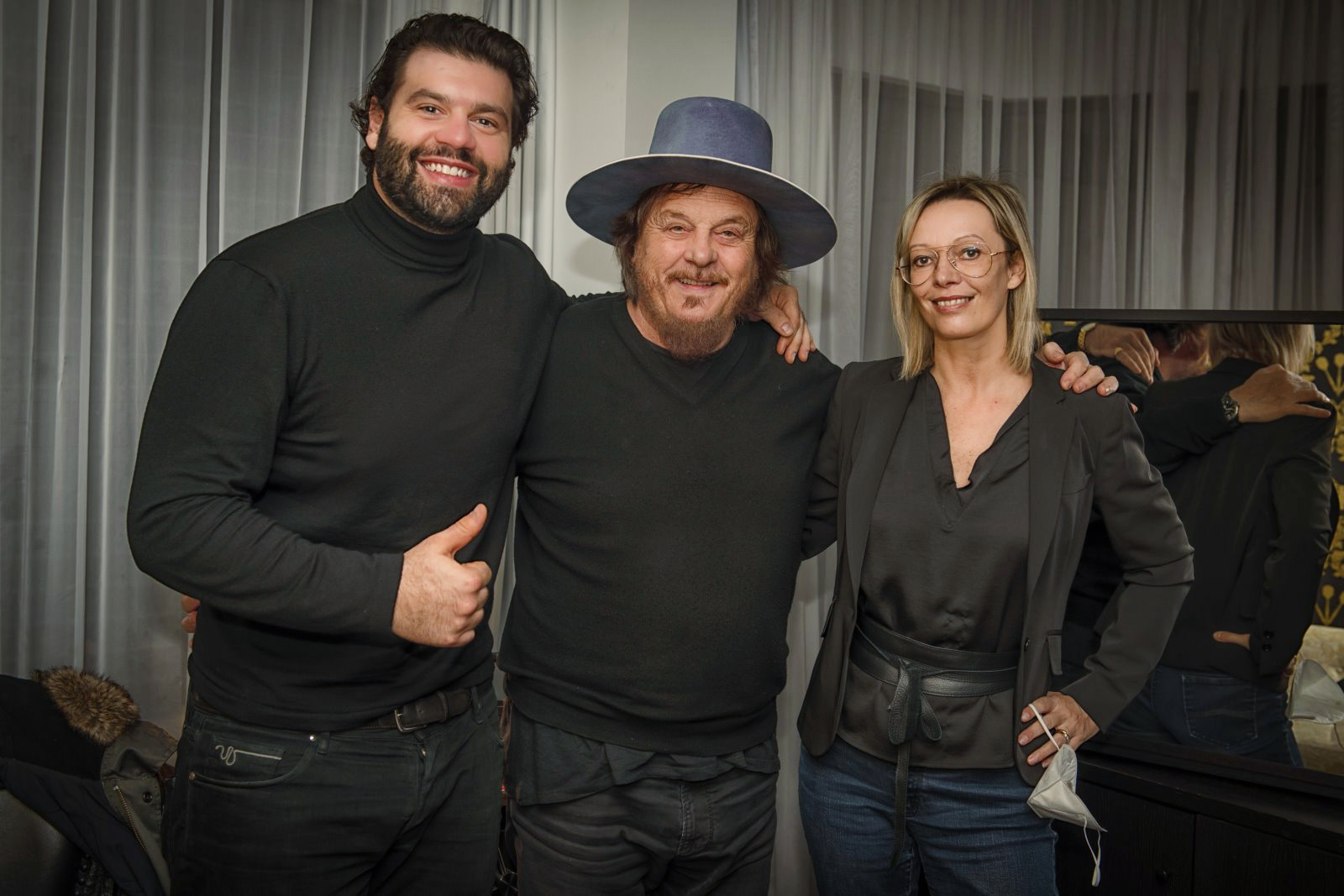





The cover photo of his new album DISCOVER is telling: in a desolate expanse of cold and snow, at the centre of the image, there he is, with a vivid blanket that brings warmth to that icy landscape. And the blanket, in my opinion, is Zucchero’s voice; that voice recognisable by anyone, which has moved and warmed the soul for forty years. For his tour presenting the album Discover, we at Tuttoitalia met him at the Kameha in Zurich for a cordial and pleasant interview that only an artist like him can give us.
Zucchero, you have done an excellent job and given a lovely gift to your fans. I would like to start the questions from the video of “The scientist” by Coldplay. Your voice sings “Tell me your segrets”: so will you reveal to us where the video was shot and the photoshoot done? “In Switzerland! In the Bernese Alps, on the largest glacier in Europe, in a remote and magnificent place with an unpronounceable name! Last summer we gave a concert right on the glacier, and so we also chose it for the album’s images. And then we also filmed in the Alps above Trento. The blanket comes from Mexico.”
It is very probably the Jungfraujoch. Let’s say that with this answer you have satisfied both Italian and Swiss pride. Let’s move on to the range of songs you chose for this album. Starting from Silent Night from 1818 to the last song with Bono from 2020, you had a vast span of time, certainly not easy to select from: “There were more than 500 titles. I had wanted to make an album like this for a long time, but I did not have the time, I was always on tour. With the pandemic I took the chance to devote myself to this project out of force majeure. In the selection there is a bit of everything, from the 1960s to today. Then I had to skim through them, because there are songs that, out of respect, I do not want to touch, because they are wonderful just as they are, and I would not allow myself to spoil them. Others because the arrangement did not convince me, others still because they did not go well with my voice. Then you get to choose 14 songs with the feature that you have managed to make them your own, as if it were your own record, but with songs by others.”
Among these songs, or even among those in the initial selection, is there a song that, straight away, particularly struck you and that made you think “I would have liked to write it”? “Many! There are a great many. I can tell you, for example, A white shadow of Pale by Procol Harum (later sung in the Italian version Senza Luce by the Dik Dik. Ed.), which is one of my all-time favourites. Some lesser-known ballads by Joe Cocker have heart-rending melodies and are extraordinary.”
.jpeg)
In the list of titles there is also Fiore di maggio by Fabio Concato. I paused to recall the lyrics and the music that I had not heard for quite some time, and I understood that you had included it because it is a beautiful song, isn’t it? “There, you see! You had forgotten it! That is why I included it: a song with remarkable melody and poetry, whose memory has not held up over time compared with other artists such as, for example, those by Battisti, of which we remember every word. And yet the quality is the same.”
So, in your opinion, is it better to interpret and rearrange a cover or to improvise an original? “They are two different things. The original sends you to bed with the doubt as to whether the words or that musical passage are right, whether they can please, and then ‘may God be good to us’. The cover is already there.”
But, in this case, doesn’t the doubt come to you that you might change it too much and think the author won’t like it? “No, because otherwise you limit yourself, you have to be free, otherwise you trip yourself up. You have to make the cover your own, you must not spoil it, but there has to be a mark. Do you know how many of my songs have been reworked, and some I liked, others a little less? But that is acceptable. And in the end it is the audience that decides.”
For an artist of your calibre, how gratifying is it to have the author’s enthusiasm when you propose doing a cover of one of their songs? “Enormously! To hear Bono say that I moved him with the version of Canta la vita that I did at the Colosseum, during the lockdown, is extremely gratifying. From these great artists who have written incredible things, it is very pleasing.”
With someone who has less experience and is young like Mahmood, on the other hand, I imagine that, as soon as he heard your voice on the phone, he immediately shouted a “Yes!” at you, regardless of whatever you had asked him: “(laughing) With him we recorded Natural blues. I chose him for his vocal timbre, he has a command and a versatility in his voice that impressed me, and I called him a soul singer, even though his kind of music is of another genre. I could well see him singing songs by Al Green. In the studio, when he saw me, he was left open-mouthed.”
I imagine there is a certain awe towards you: “But you know, I am 66 years old, I have been making music for 40 years, I think I have written something good. In short, I too would be intimidated if I were young and met Eric Clapton or Elton John.”

Making a digression from your album and referring again to the duets, I wanted to congratulate you on the feature in the song with Van De Sfroos sung in Lombard dialect. For this reason, in my imagination, I would not be surprised to see you sitting on a rocking chair under a porch in New Orleans, I would not be surprised to see you in a pub in Dublin drinking a Guinness with Bono, but I would not be surprised either to see you in a trattoria speaking dialect in an Emilian province: what is your true context? “But, in reality, I am all of this. I have been going to the trattorias with friends for a lifetime and we still have fun together; when I am with Bono I go to the pubs behind the Clarence hotel in Dublin, and I have shot many videos in New Orleans, which I love very much, as in the latest album Black Cat or Baila.”
This makes you a more human, more approachable VIP than certain idolised singers, don’t you think? “My audience has never abandoned me, and that is why I believe it. I have always been myself and I have always given a great deal, without strategies to be unreachable. I go where there is playing to be done, both to present my songs and out of gratitude towards my fans, but I do not know whether it is good or bad to be regarded as divine or not. If Mina gave a concert now, everyone would go to see her because she has chosen no longer to appear in public. She would sell out, as Celentano would. In this way this aura of legend and of the singer’s charisma is created. Some artists choose not to show themselves, others, like me, do the opposite; I do not know what is right or wrong. I have a loyal audience both in Italy and in Switzerland, but also in England, where it is hard for an Italian to establish himself. I owe this also to the relationship with the artists I have collaborated with, which has lasted a long time, from Pavarotti to Sting to Brian May. I think that this way of being of mine fulfils me, without asking myself whether it is better to be present or to make oneself desired. In the end, deep down, I simply make a living from music.”
The time for the interview has run out. We recall that Tuttoitalia’s first interview with an Italian singer dates back to 2008 and was in fact done with Zucchero (below we again offer the video interview with Zucchero from 2008). And how could one not confirm to him that, with humility, willingness and a very rare talent, over all these years, he has won the aura of a divine legend all the same? See you at his concert on Sunday 5 June 2022 at the Hallenstadion in Zurich.
Tickets already purchased remain valid for the new date. The advance sale of additional tickets begins straight away