

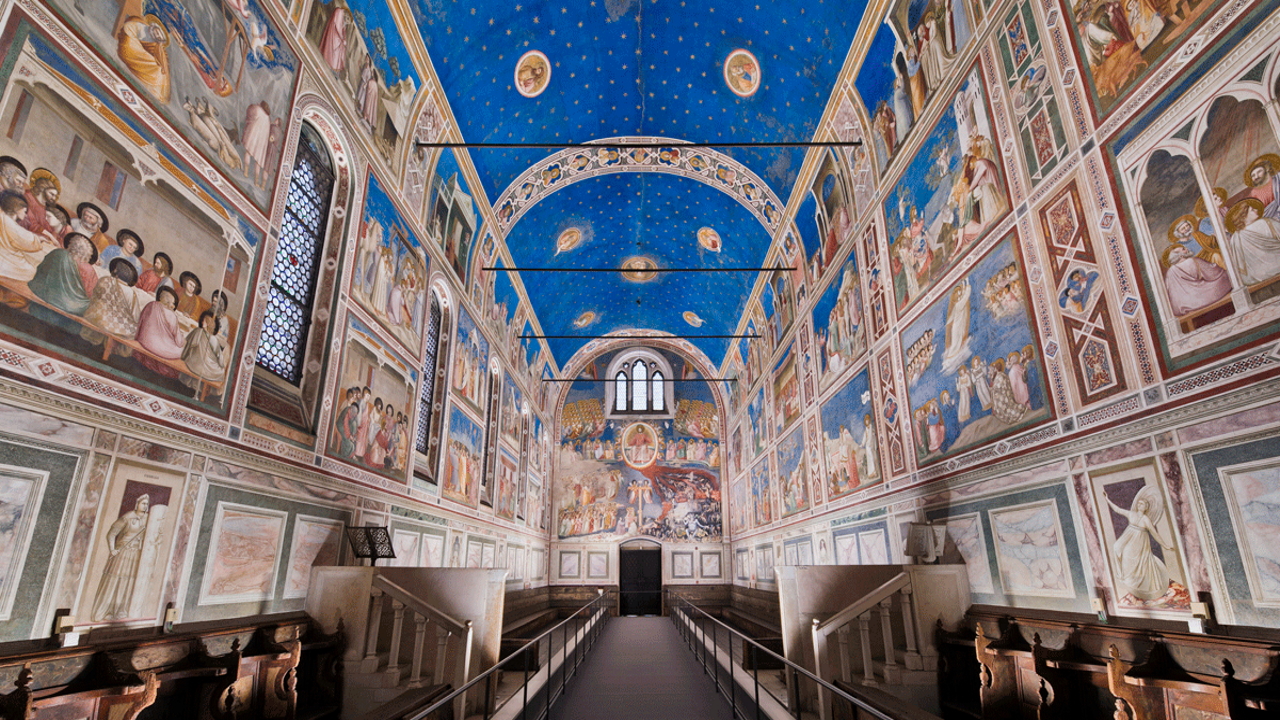


The Scrovegni Chapel, known to everyone by the surname of its patron Enrico Scrovegni, who is portrayed in a fresco detail in the act of handing over the chapel itself, is dedicated to Santa Maria della Carità and is known throughout the world for the extraordinary pictorial cycle painted by Giotto. The work is the artist's greatest fresco masterpiece and bears witness to the profound revolution that the Tuscan painter brought to Western art.

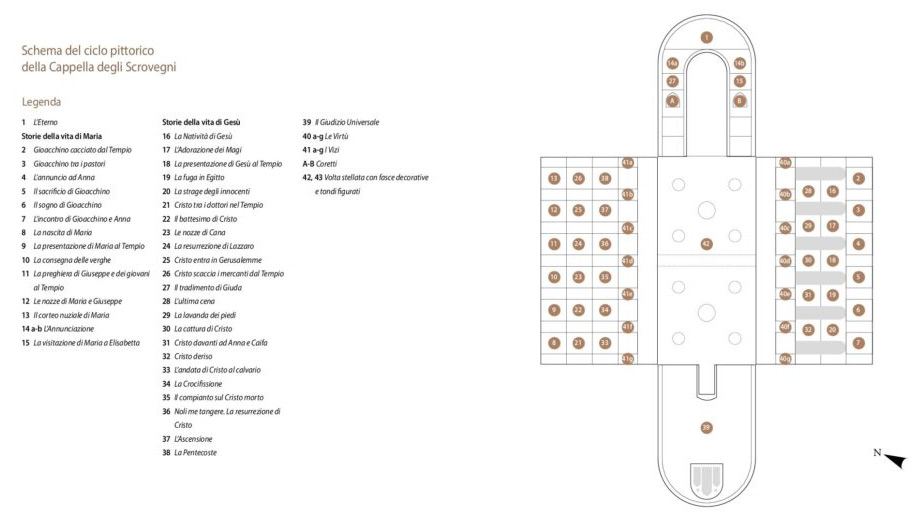
The cycle frescoed by Giotto in only two years, between 1303 and 1305, unfolds across the entire inner surface of the chapel. The vaulted ceiling is a blue mantle of stars and features the figures of Mary, of Christ and of the Prophets. The presbytery still holds the sculptural group Madonna and Child between two angels, made by the great sculptor Giovanni Pisano at the beginning of the fourteenth century. On the walls the History of Salvation is told along two different paths: the first with the Stories of the Life of the Virgin and of Christ, painted along the naves and on the triumphal arch.

The second begins with the Vices and the Virtues, dealt with in the lower part of the main walls, and ends with the majestic Last Judgement on the entrance wall.Photo Last Judgement.

The first great revolution achieved by Giotto in Padua lies in the representation of space: one can admire examples of “perspective” and of rendering of the third dimension that anticipate Renaissance theories by a hundred years.

The second is the attention paid to the representation of the human being, in physical and emotional terms: Giotto expresses this well in the Stories of the Life of the Virgin and of Christ, in which human joys and sorrows emerge with intensity, and of which a significant and celebrated example remains the tenderness of the kiss of Joachim and Anne, the first kiss in the history of Italian art.

The last restoration of the frescoes dates back to 2007. In 2021 the fresco cycle of the Scrovegni Chapel was inscribed on the UNESCO World Heritage List.
Below you will find further information and the details for buying tickets: https://cappelladegliscrovegni.vivaticket.it
At the end of October 2023 the exhibition “Lo scatto di Giotto. La Cappella degli Scrovegni nella fotografia tra ‘800 e ‘900” was inaugurated at the Museo Eremitani in Padua, next to the Scrovegni Chapel

Curated by the Musei Civici, the Biblioteca Civica and the Ufficio Patrimonio Mondiale, and promoted by the Culture Department of the City of Padua, the exhibition reconstructs through a composite display the extraordinary visual fortune of the Scrovegni Chapel. Known throughout the world as the absolute masterpiece frescoed by Giotto, the Scrovegni Chapel was nonetheless, as few people know, among the first Italian monuments to be reproduced in photography in a systematic and precise way: it was Carlo Naya, one of the Italian pioneers of photography, who captured it for the first time in the summer of 1863, less than twenty-five years after the official invention of this technology.

The exhibition then turns to the twentieth century through the famous photographic campaigns of the Florentine publishing house Alinari, directed by Domenico Anderson. The images of the Scrovegni Chapel entered art catalogues from 1906 onwards and travelled around the world thanks to the editions translated into English and French. Alinari is also responsible for the first colour photographic campaign of the Scrovegni Chapel: the year is 1952 and Giotto's masterpiece has already become the subject of a cinematic work.

In 1938 the very young director Luciano Emmer made the first film on the Scrovegni Chapel. Shot in 35 mm using an old Pathé camera from 1913 and a handmade truca, used to create animations, special shots and particular effects, Emmer drew up the storyboard by sketching in charcoal on the photographs and then filming frame by frame, acknowledging that “the film on Giotto can be considered the first Italian neorealist film because, on close inspection, the walls of the Scrovegni Chapel are in fact a kind of storyboard: I limited myself to filming it”. Later Pier Paolo Pasolini too made Giotto's masterpiece his own, using it explicitly in the scenes of the Decameron of 1971.
The exhibition will remain open until 7 April 2024 and access to the installation is included with the ticket of the Museo degli Eremitani, which can be bought at this link: https://cappelladegliscrovegni.vivaticket.it