



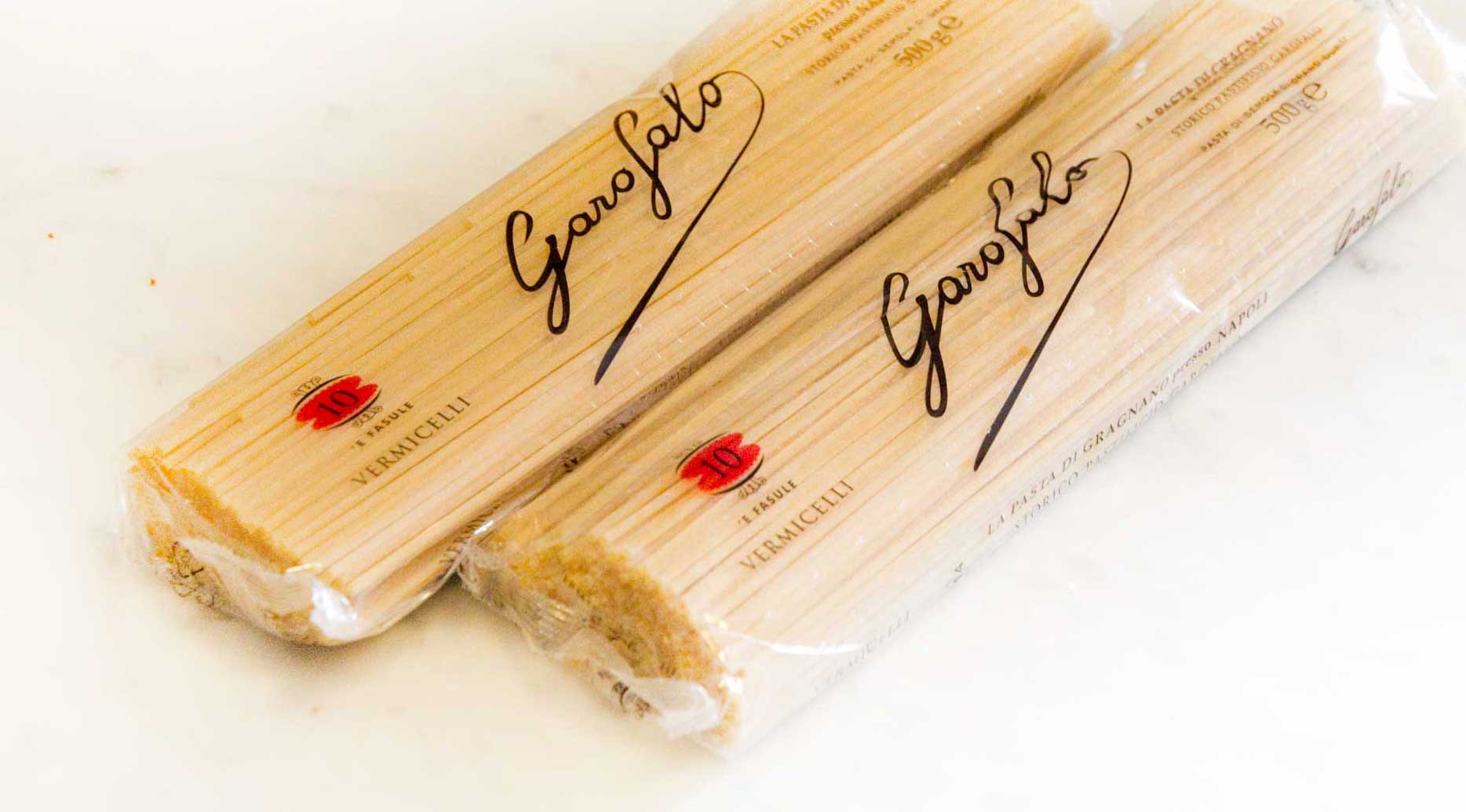


The Pastificio Lucio Garofalo S.p.A. is an Italian company specialising in the production of pasta, founded in 1789 in Gragnano, in the province of Naples, where it still has its registered office and production plant today. The perfect climatic conditions for drying pasta and the presence of spring water that fed the mills made Gragnano the ideal place for pasta production. At the end of the eighteenth century, Mr Michele Garofalo obtained, by Royal Decree, the exclusive concession for the production of pasta. Time has rewarded the original formula of Garofalo, which combines the drive for innovation with the unstoppable pursuit of quality. The company thus became a driver of the “gragnanese” evolution, and to a first industrial plant in the centre of the town another was added in the immediate vicinity. Production grows and Garofalo expands above all abroad and as a private label, until in 2001 an own-brand line is launched in Italy that immediately becomes, among consumers, a benchmark for pasta with excellent characteristics. Today Garofalo, as well as being a leader in Italy for quality pasta, exports its products to more than sixty countries all over the world. At the root there is the passion for excellence and the carrying forward of the precious tradition of the land where the wheat is worked with so much love. The semolina is only of the finest choice, obtained from the milling of the best Italian wheats. There is care in checking the gluten level and attentive control of the parameters of colour and flavour of the selected wheat. The production process of dry pasta is the result of centuries of history and tradition; it has changed over time, but the product has remained the same: a simple mixture of semolina, durum wheat and water. While soft wheat flour is also used for fresh pasta, for dry pasta in Italy exclusively durum wheat semolina is used, which contains that tenacious gluten that allows it to hold its cooking and remain al dente. The IGP designation, which stands for Protected Geographical Indication, is reserved for pasta products that meet the conditions and requirements established by this production specification. The Pasta di Gragnano is the product obtained from the dough of durum wheat semolina with water from the local aquifer.
SPAGHETTI 9 GAROFALO
Rough to the touch thanks to bronze-die extrusion, Garofalo spaghetti hold sauces perfectly. The shape is long and thin, the cross-section round, the possible pairings infinite given the great versatility of this type of Pasta di Gragnano IGP.
LINGUINE 12 GAROFALO
Originally from the Gulf of Genoa, they were created to accompany pesto. Garofalo linguine enhance vegetable- or fish-based sauces. They are a Gragnano IGP pasta format. Thanks to their flattened and slightly convex shape, together with the rough, porous, bronze-drawn surface, they capture the sauces and give back their genuine flavour.
Gragnano is an Italian municipality of 28,857 inhabitants in the Metropolitan City of Naples in Campania. It is known throughout Europe as the “City of Pasta”. In Italy it is indeed the city that produces and exports the largest quantity of pasta, especially maccheroni. Since 2013, the distinctiveness of pasta production has received the European recognition of the Protected Geographical Indication “Pasta di Gragnano”. It is located in the southern part of the province of Naples, at the foot of the Monti Lattari, almost entirely surrounded by mountains: Monte Muto, Monte Sant'Erasmo, the Colle di Carpeneto and finally Monte Pendolo. The production of pasta, in particular of maccaroni, which made Gragnano famous around the world, dates back to the end of the 16th century, when the first family-run pasta factories appeared. The production of these same maccaroni became truly important only from the middle of the 17th century, when the majority of Gragnano's inhabitants devoted themselves to pasta production. The production of the “white gold” was and is favoured by particular climatic conditions, such as slightly humid air that allows slow drying, and the quality of the spring water that fed the mills and helped give the dough a particular flavour.
https://prodotti.migros.ch/garofalo-spaghetti
https://prodotti.migros.ch/garofalo-linguine






.jpeg)


